


Real Hebrew, every day.
Today's Israeli news and songs, made readable at your level. Translation, audio and nikud on every word.


Free to start.
Today's story
Every weekday our editors take a story Israelis are reading and write it in easy Hebrew at one of four levels. This is today's. Tap a word and see what the safety net looks like.

נְתַנְיָהוּ רוֹצֶה לְהָקִים מֶמְשָׁלָה רְחָבָה בְּרָאשׁוּתוֹ
Netanyahu wants to form a broad government under his leadership
Read this in the app →How it works
Pick your level
Four levels, from first steps to advanced. Not sure? Start one level below where you think you are and move up when it feels easy.
Read today's story with a safety net
Tap any word for its meaning, root and audio. Turn nikud on or off. Listen to the whole story read aloud, as slowly as you like.
Save words and review them until they stick
Every word you tap goes to My Words. Flashcards bring it back at the right moment, and Word Snake and the grammar games turn the review into a game.
What is in the app
Real Israeli news and songs, with every tool you need to read them.
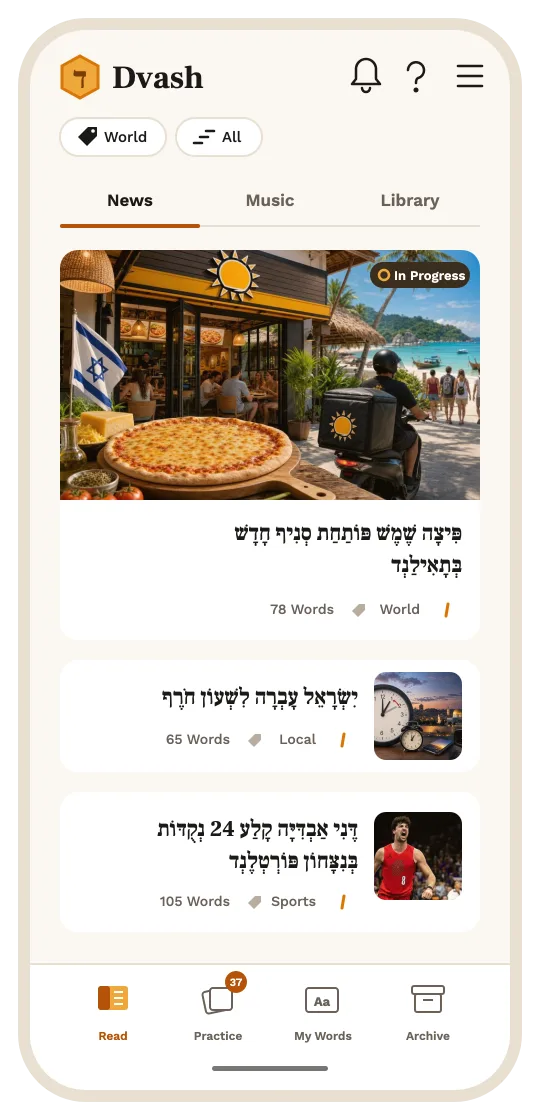
Easy Hebrew news, every weekday
Short stories about what is happening in Israel and the world, each written at one of four levels. 386 articles per language so far, and a new one every weekday.
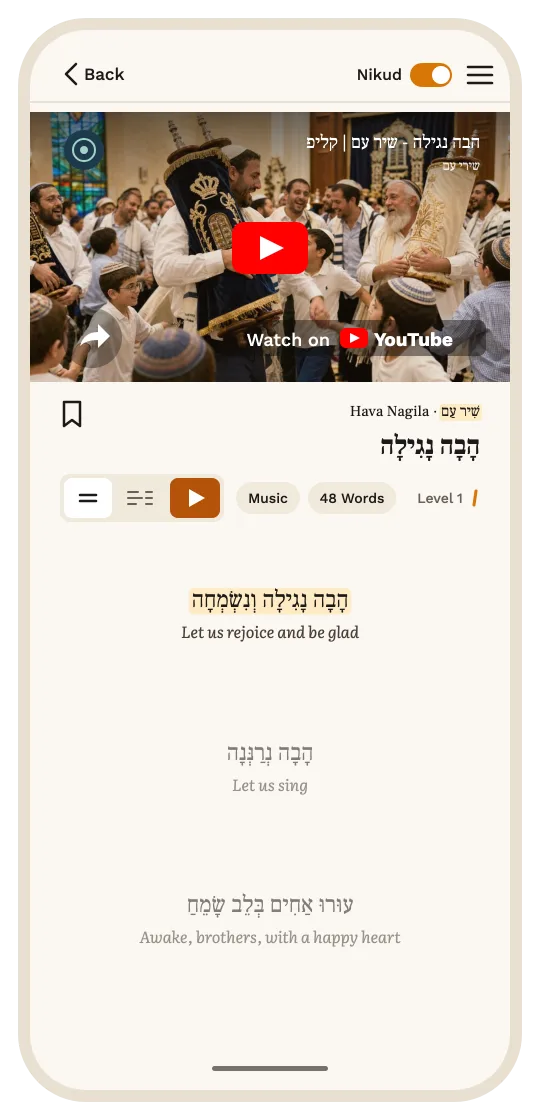
Israeli songs with line-by-line translation
From this year's hits to the songs everyone sings at the Shabbat table. Each line translated, the audio in sync, every word tappable.
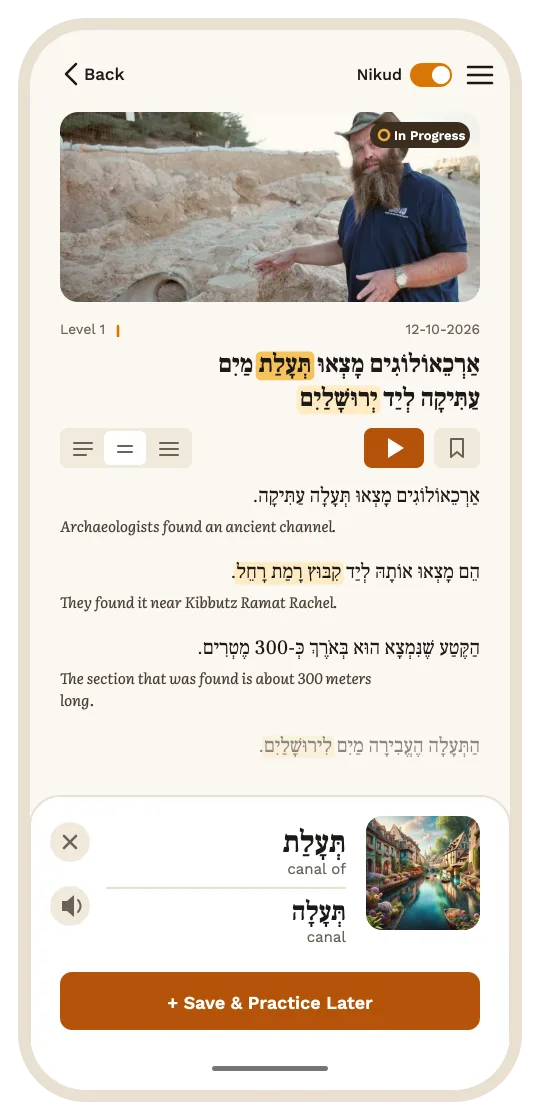
Tap any word
Meaning, base form, root and audio, in the context of the sentence. Long-press a sentence for its full translation. Nikud on or off, whenever you want.
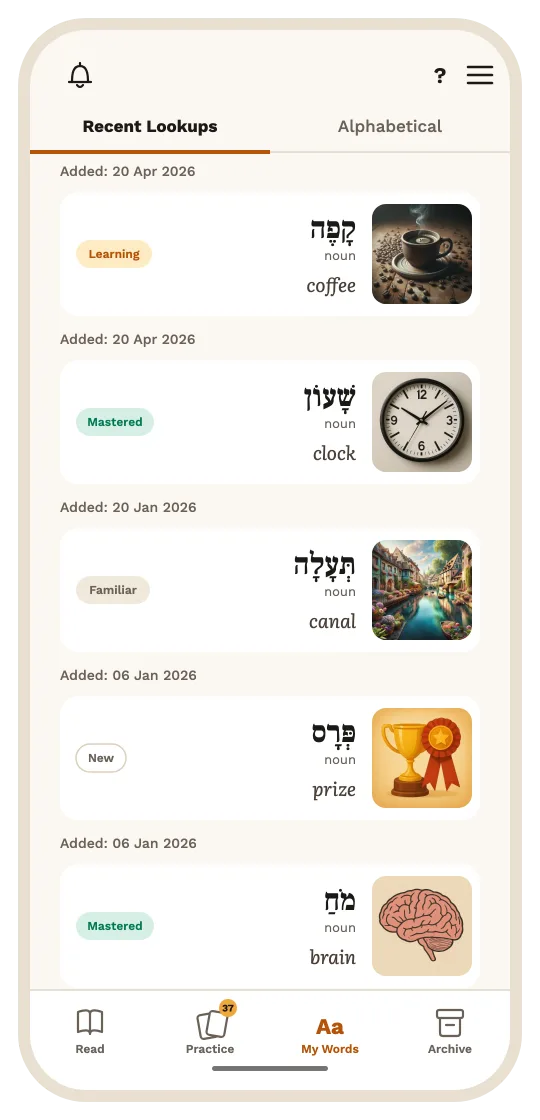
Words that come back until they stick
Every word you look up is saved to My Words. Flashcards with spaced repetition bring it back just before you would forget it.
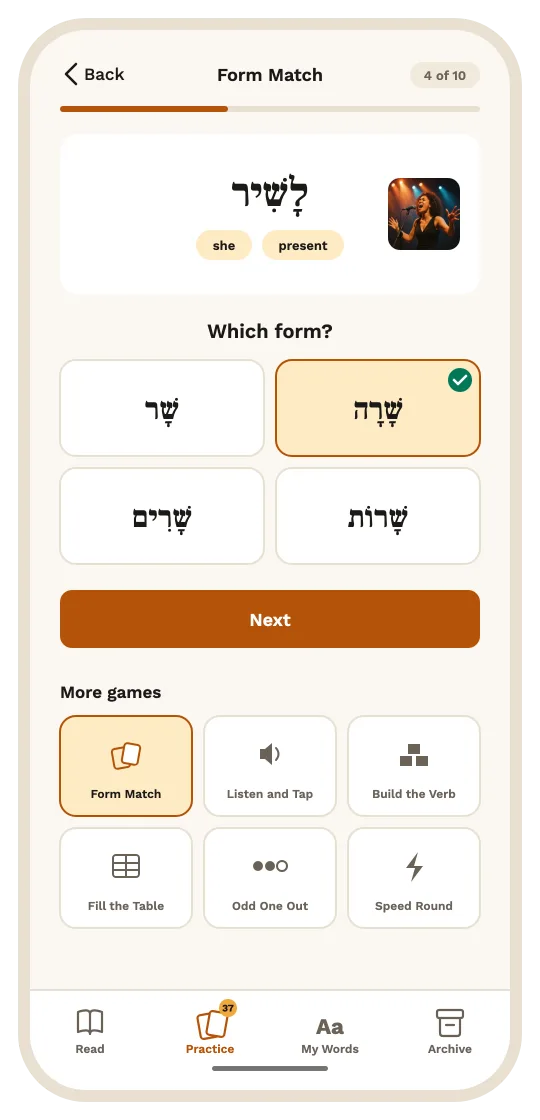
Grammar gamesNew
Six quick games built on real verb tables: Form Match, Listen and Tap, Build the Verb, Fill the Table, Odd One Out and Speed Round. The verb forms ulpan drilled, in two minutes a day.
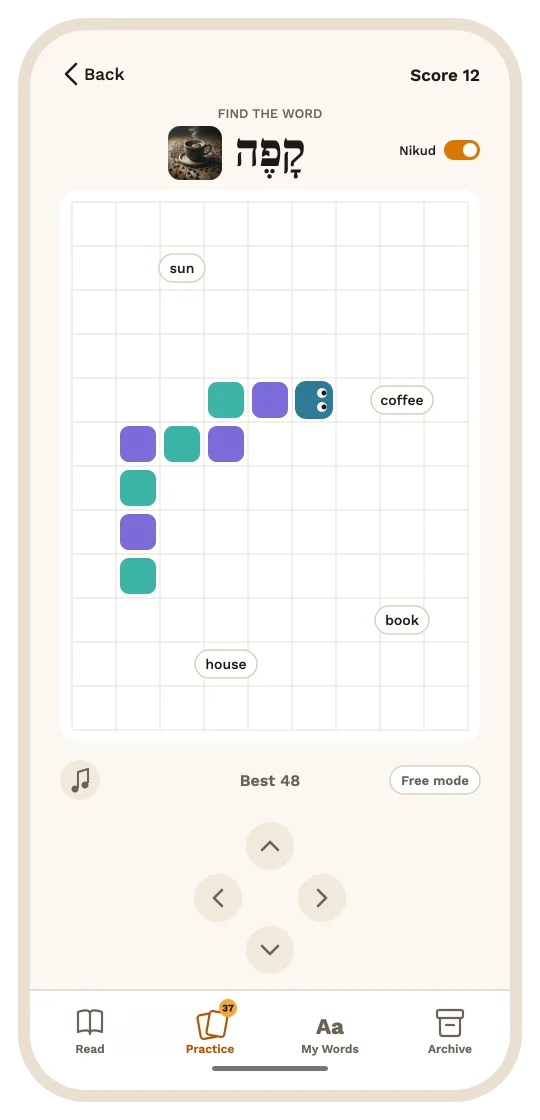
Word SnakeNew
Steer the snake to the right translation of the word on screen. A wrong answer makes the snake longer. Every round counts toward your spaced repetition.
What learners say
Reviews from the App Store and Google Play. 4.9 stars on the US App Store.
Common questions
All questions and answersWho is Dvash for?
Dvash is for people who already know some Hebrew and want to live in it: after ulpan, after a course app, or on your own from abroad. If you can read a simple sentence slowly, start at level 1. If you are still learning the alphabet, learn it first and come back.
What kind of content does Dvash offer?
Every weekday, a short story about what is happening in Israel and the world, written in easy Hebrew at one of four levels (1 to 4). Plus a library of short texts about Israeli life and culture, and Israeli songs with line-by-line translation and audio in sync.
What are the four Dvash levels?
In the CEFR scale from A1 to C2, level 1 is roughly A1 to A2. Level 2 is A2 to B1, usually leaning toward B1. Level 3 matches B2, and level 4 covers C1 to C2.
How should I use Dvash?
Ten minutes a day, every day. Pick a story that interests you at your level. Read it and tap the words you do not know. Then listen to it a few times, until it feels easy. Finish with the short quiz. Keep that up and your vocabulary and comprehension grow faster than you expect.
Can I save words for later practice?
Yes. Tap any word in a story to see its translation and hear it. It is saved to My Words, and flashcards with spaced repetition bring it back until it sticks.
What is spaced repetition?
Spaced repetition is a review method that shows you a word again just before you would forget it. Hard words come back often, familiar ones rarely. It is the most efficient way to turn words you looked up once into words you own.
Should I save all unfamiliar words?
No. Reading and listening every day teaches you most words by itself, because the important ones keep coming back. Save the words that are hard for you, or the ones you cannot afford to forget, and let spaced repetition do the rest.
Real Hebrew, every day. Starting today.
Get the app, pick your level and read today's story. Free to start.